
Products / Laser Profiler
LP-2000 · MATERIAL BED THICKNESS
See what’s really
on the belt.
Measure material bed thickness across the full conveyor width continuously, without stopping the line.
Discuss your profiling application ↗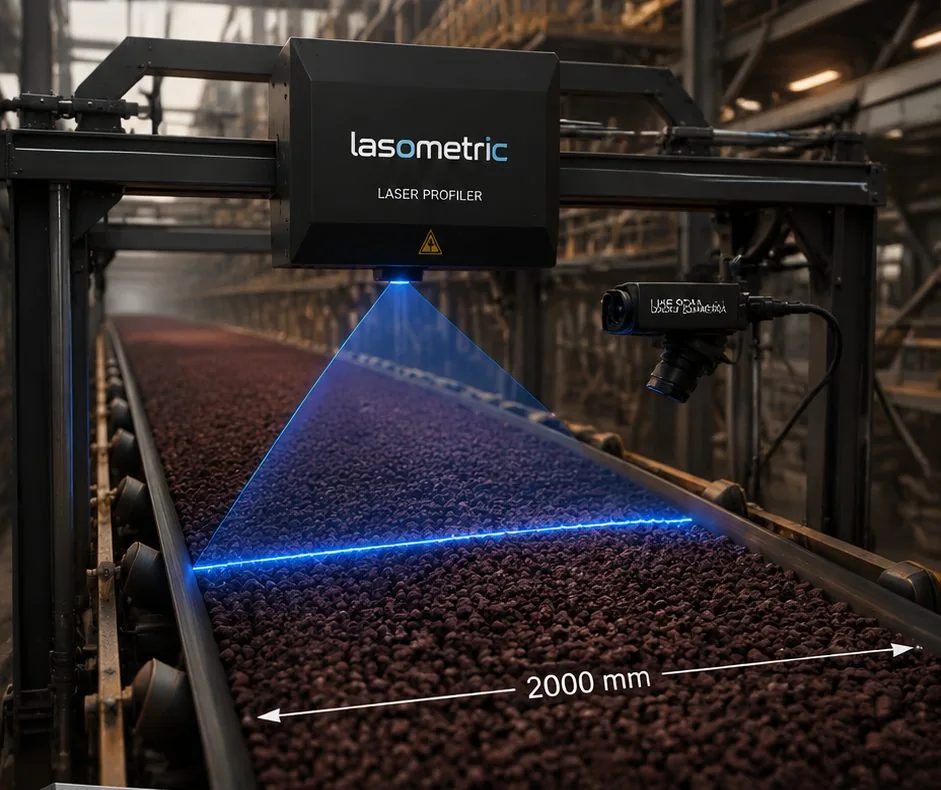
THE MEASUREMENT GAP
An average depth hides variation.
Uneven bed depth changes the path of airflow through a traveling grate. A full-width profile shows where material runs thick or thin, so the plant has a more useful input for monitoring and control.
STANDARD / REFERENCE CONFIGURATION
Plan around the measurement point.
| Measurement width | 2,000 mm; custom widths on request |
|---|---|
| Bed thickness range | 0–60 cm; typical operating range 10–30 cm |
| Measurement principle | Laser triangulation with structured line projection |
| Laser source | Blue diode line laser, Class 3R |
| Profile rate | Up to 25 profiles/second |
| Repeatability | ±2 mm across the full scan width |
| Camera | High-speed monochrome line-scan sensor |
| Enclosure | IP65 industrial steel housing |
| Operating temperature | −20°C to +55°C |
| Mounting | Overhead gantry; fixed span above belt centerline |
| HMI | Touchscreen; live profile and alarm status |
| Communication | Ethernet/IP, Modbus TCP, OPC-UA; protocol on request |
| Safety | Local E-stop, laser interlock, green/amber/red status beacon |
These figures are a planning reference; final configuration is confirmed during application engineering and the site survey.
One profile, every screen.
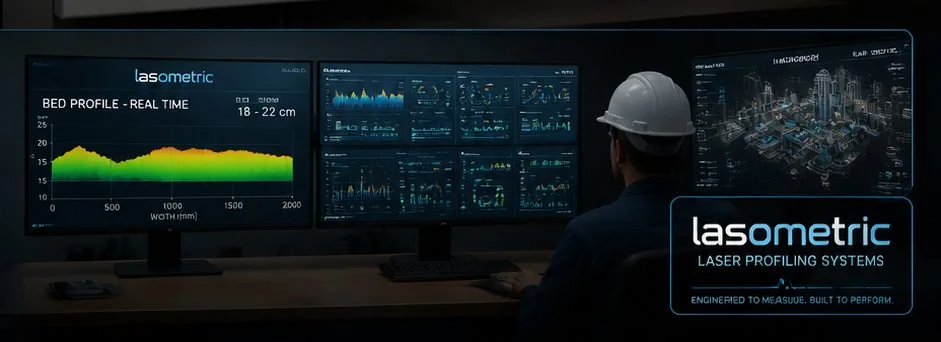
Use live profiles, trend history and configurable thickness alarms on the HMI and control-room workstation. Historian export supports process reporting.
Traveling-grate application
Map the profile to windbox zones and evaluate draft, firing rate and grate-speed corrections with the plant control team.
Measure → Map → Correct → Sustain →Questions about the measurement point
Can the measurement width be customized?
The standard reference width is 2,000 mm. Custom widths are available on request, with final sizing confirmed for the application.
What information supports configuration?
Conveyor/grate width, material, expected bed depth, belt speed, mounting environment and communication requirements.
FROM DATA TO A PLANT DECISION
What the measurement makes possible.
Process benefit
Profile variation across the width and map it to plant process zones.
Operational outcome
Support more consistent bed conditions and a clearer basis for operator or engineered control decisions.
OPERATOR VISIBILITY
Bring the profile into the control room.
APPLICATION ENGINEERING
Discuss your installation.
Share your process details to help us assess the measurement point and configuration.
FROM MEASUREMENT TO A PRACTICAL DECISION