
Products / Belt Health Monitoring
BHM-1 · LASER + VISION + THERMAL
Catch belt damage
before it fails.
Inspect the running belt and map defects to belt position, supporting earlier maintenance decisions.
Discuss your belt inspection ↗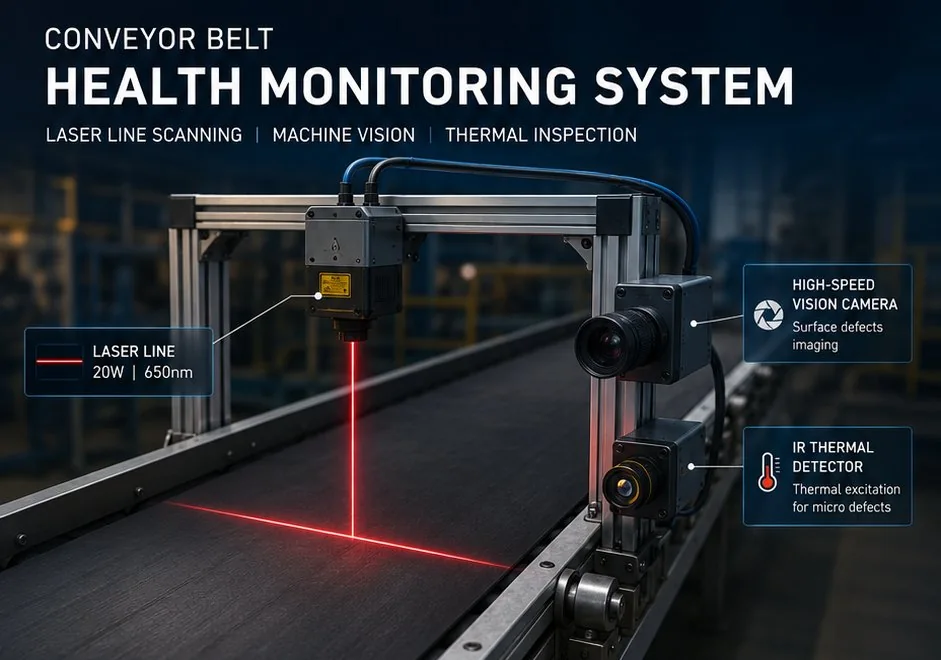
COMPLEMENTARY INSPECTION MODES
Look at the surface. Investigate beneath it.
VISION / TRIANGULATION
Surface damage
Tears, cuts, holes, splices and gouges are detected and mapped through surface imaging.
THERMAL EXCITATION
Subsurface indications
Thermal inspection supports detection of indications associated with micro-cracks, delamination and corrosion.
Illustrative layers; these diagrams do not show actual test results. Detection suitability depends on the belt and site configuration.
From reference line to maintenance action.
One dashboard, full belt status.
Live vision and thermal views, defect history and system status support inspection planning. Live monitoring combines vision and thermal views with belt-position mapping.
Reference configuration
| Laser line scanner | 20 W; 650 nm |
|---|---|
| Vision camera | High-speed industrial camera; triangulation-based surface imaging |
| Thermal detector | IR thermal camera; thermal-excitation subsurface inspection |
| Analysis | Automated detection, classification and belt-position mapping |
| Data transfer | Real-time high-speed link to control unit / local laptop |
| Software | Live views, defect log, alerts, reports and historical trends |
| Mounting | Overhead gantry; fixed span above belt centerline |
| Environment | IP65; −20°C to +55°C |
| Communication | Ethernet/IP, Modbus TCP, OPC-UA; protocol on request |
| Alerts | Configurable defect alerts and automated reporting |
Final configuration confirmed per project during the site survey.
Questions about belt inspection
How are surface and subsurface indications distinguished?
Vision/triangulation inspects visible surface geometry. Thermal-excitation inspection evaluates subsurface indications; suitability is assessed for the belt and conditions.
What information supports configuration?
Conveyor length, belt type, width and speed, failure modes, inspection priorities and operating environment.
FROM DATA TO A PLANT DECISION
What the measurement makes possible.
Process benefit
Classify surface damage and subsurface indications, map belt position and track condition over time.
Operational outcome
Support earlier maintenance attention and planning that can reduce unplanned disruption. Outcomes depend on the belt and operating conditions.
APPLICATION ENGINEERING
Discuss your installation.
Share your process details to help us assess the measurement point and configuration.
FROM MEASUREMENT TO A PRACTICAL DECISION